24 April 2026
The Uncreated Bridge — a new valence
University of Craiova Gallery · ROMCON XLVII
The infrastructural valence of the project · emblem-image launched on this occasion · curated by the author.
Who produces the meaning of the image in an age dominated by technology? And what happens to the gaze when the algorithm becomes a creative partner?
The Uncreated Bridge investigates the relationship between the human gaze and digital visuality, focusing on how perception is reshaped by technology. If in Between Times time was the working material, here the central theme becomes the gaze — the way in which the image is generated, perceived, and reinterpreted through digital media.
The title carries a double meaning: bridge designates the connection between the human gaze and the technologically generated one, while uncreated suggests the intermediate state of the image — a hybrid visual construct, situated between human control and the autonomy of the digital process. The bridge in the title is not an object, but a process. It is not a stone bridge, but a repeated gesture, a sustained intention, a continuous choice.
The project functions as a perceptive and reflexive experiment: an attempt to „see" the world through technology, while at the same time examining how technology rewrites the logic of the gaze, of memory, and of visual representation.
The project aligns with the posthuman theories of Joanna Zylinska, who argues that generative art is not a simple mechanical reproduction, but a form of coexistence between human thought and automated processes of visual generation.
Through the alternation between algorithmic generation and collage, the work claims a space of ambiguity: the resulting image is neither entirely artificial nor entirely human. This ambivalence reflects what Lev Manovich calls procedural aesthetics — a type of art in which the process becomes more important than the finished result.
On the perceptual plane, the work proposes an experience in which the viewer is no longer a passive spectator but a participant in the visual construction — what Claire Bishop defined as the participatory spectator: a figure who no longer contemplates the work, but contributes to its meaning. The role of the author thus shifts from operator to curator of variability.
The series was made through algorithmic generation and digital collage in Adobe Photoshop, combining visual synthesis tools based on AI functions — Generative Fill and Neural Filters — with manual interventions of selection, overlay, and fusion of layers.
In this configuration, technology is no longer just a medium, but an interlocutor — an instance that participates in the construction of visual meaning.
The Uncreated Bridge confirms the operation of the Attention–Intention–Message model within a hybrid human–AI framework.
Concentrated through the compositional tension between human and robotic hands, sustained by composition vectors, rhythm of fragmentation, and luminous accentuations in the near-touch zone.
The investigation of the negotiation between human control and algorithmic autonomy, operationalised through generation parameters, controlled iterations, and curatorial selection of versions.
The transfer from representation to process, making visible the technological co-authorship and the human responsibility in articulating meaning.
The central leitmotif of the first part is the gesture of hands: the human hand — warm, imperfect, alive; the robotic hand — cold, precise, programmed. Between them remains a small but infinite space — a suspended gesture, an unspoken question. The series includes works such as The Ascent of Fragments, The Decisive Move, The Silent Witness, and The Ecology of Time, each proposing a distinct relationship with the theme of fragile coexistence between human perception and algorithmic logic.
Can we touch each other without losing ourselves?
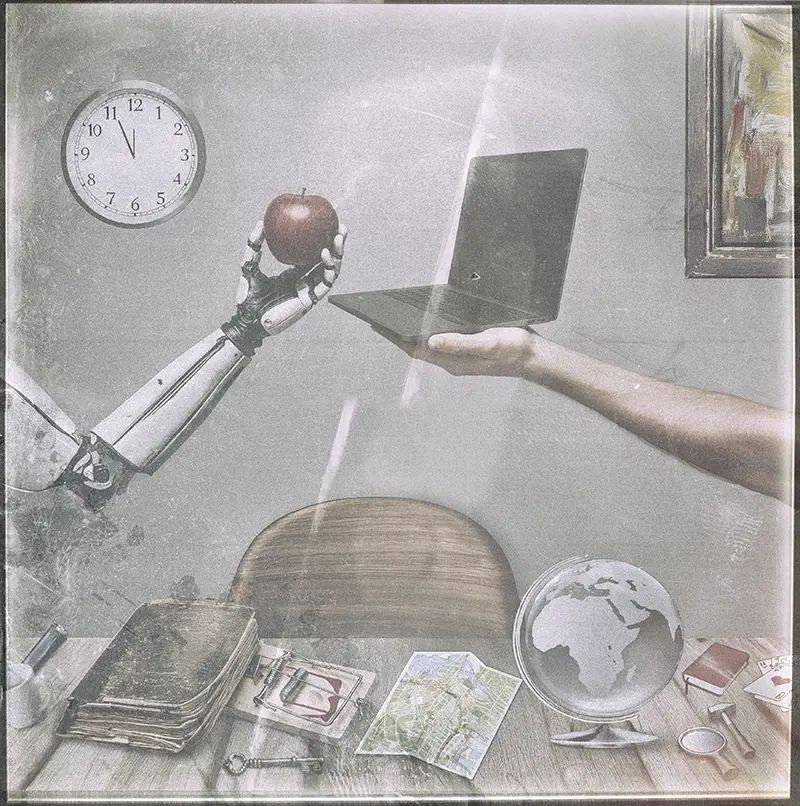
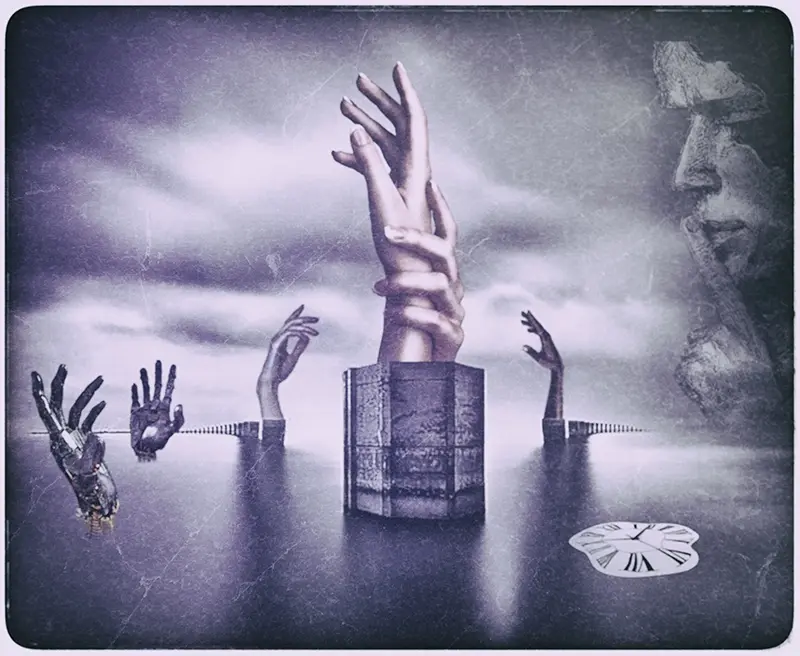


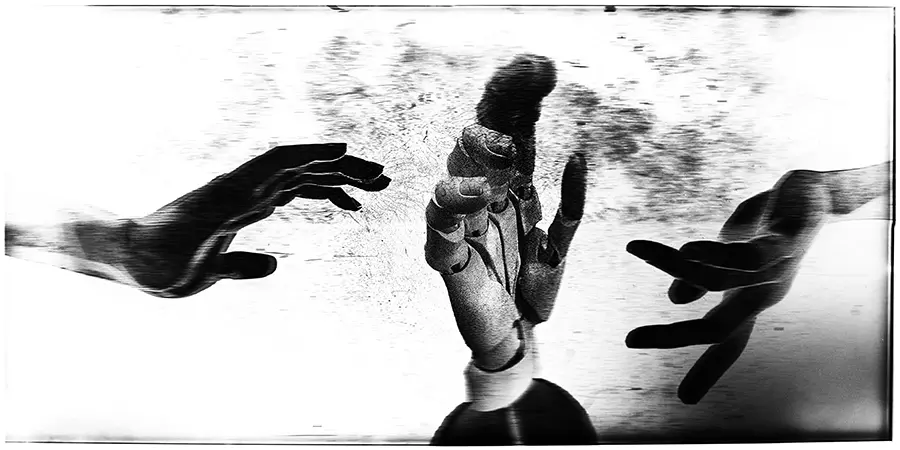
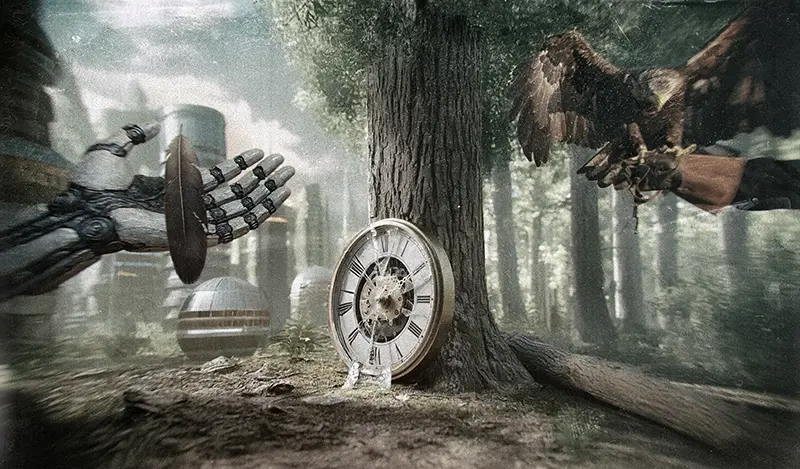
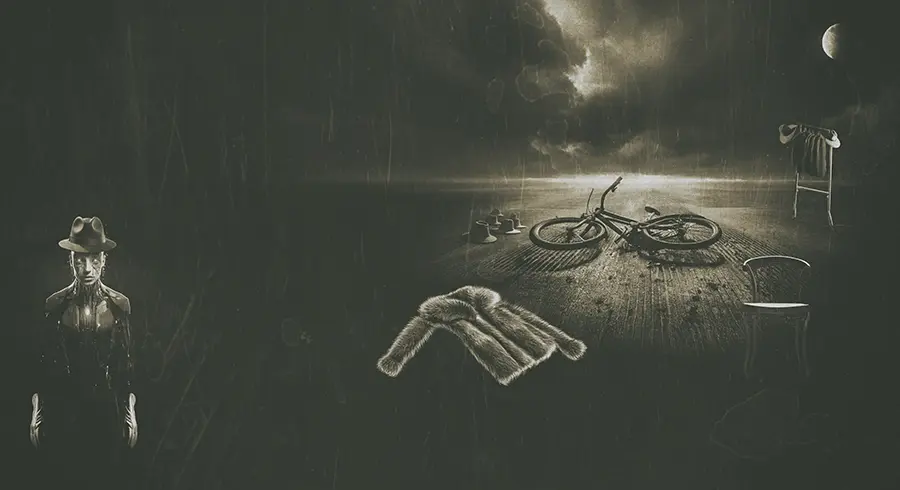
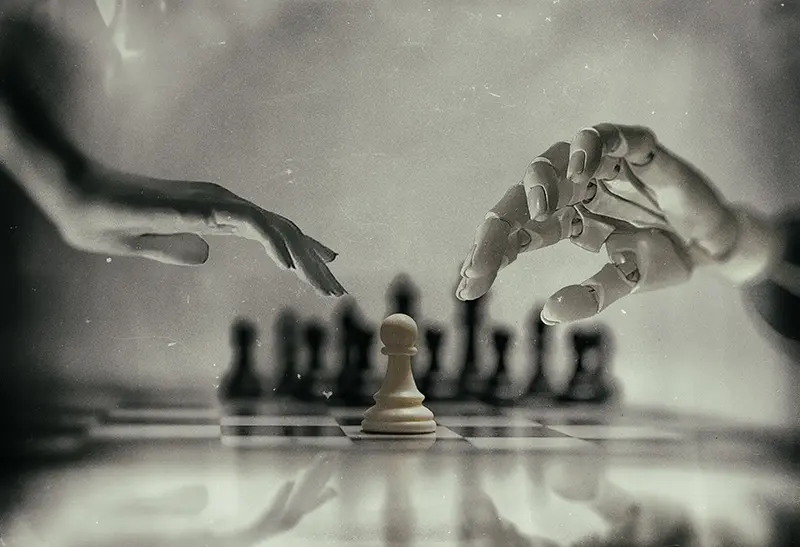

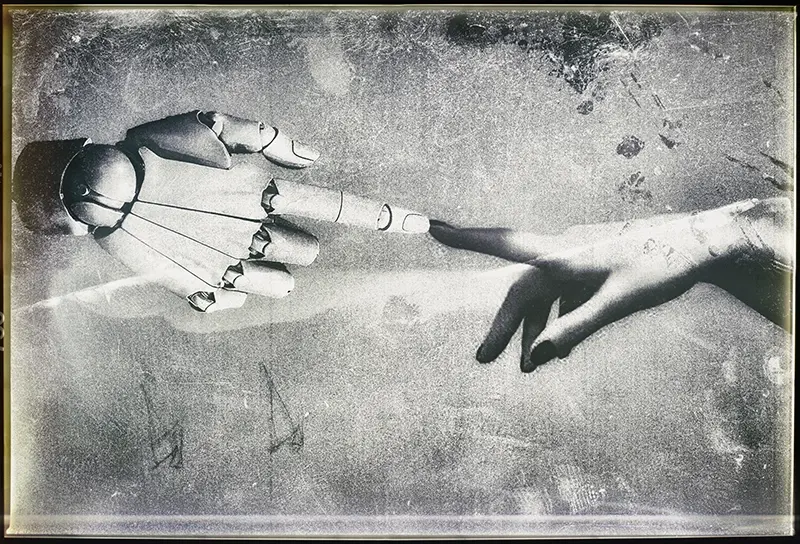
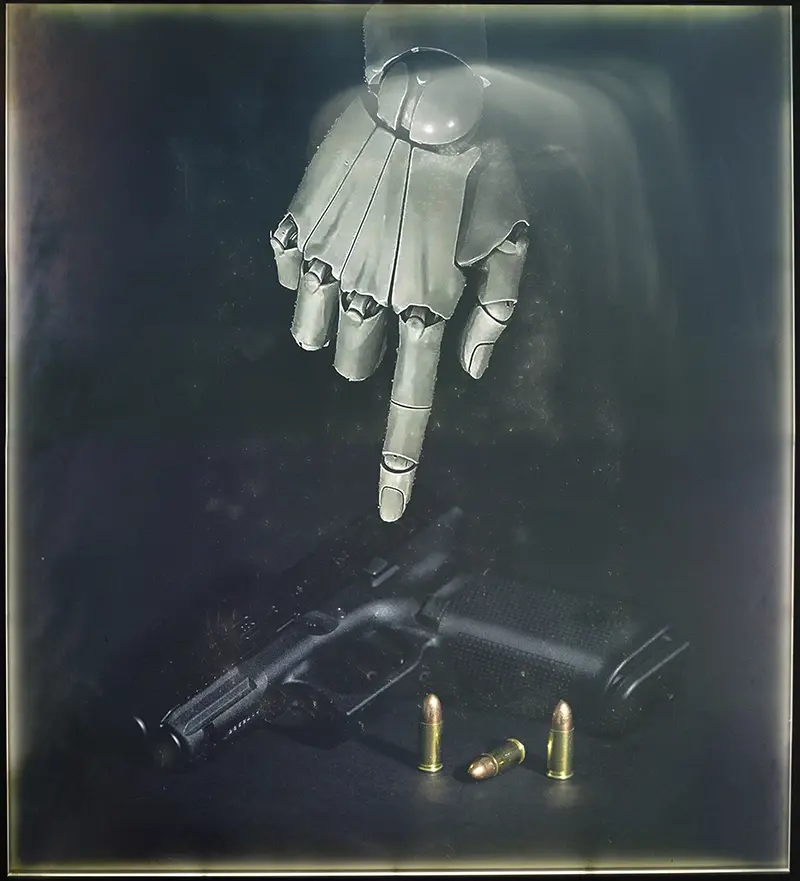

The Uncreated Bridge develops a post-anthropocentric aesthetics in which the image becomes a space of coexistence between human and technology — not belonging to a single author, but resulting from a collaborative process in which human and digital perception complement each other.
The message is not total reconciliation, but the mapping of a fragile coexistence between sensory memory and programmed logic: authorship is distributed, and identity is negotiated in the contact zone between skin and circuit.
The Uncreated Bridge began as a study of the suspended gesture: a human hand and a robotic hand, close without touching, with that small and infinite distance between them where it was being decided whether touch is possible without loss. It was a chamber study, intimate, focused on contact — on the question can we touch each other without losing ourselves?
The body of works developed for ROMCON XLVII, at the University of Craiova, does not abandon this question but shifts it to a different scale. If the initial series looked between two hands, the works in Craiova look around the human being: it is no longer a matter of a gesture, but of an infrastructure. The bridge no longer links two beings — it links the individual to the system that has taken over, one by one, the functions once interior to the mind. Memory, judgement, identity, decision, consciousness, testimony: each has been externalised, delegated, deposited in an architecture that now stands before the human being as an interlocutor greater than them.
From this, the common visual grammar of this valence. The human figure appears almost always from behind — not a protagonist, but a witness, seated or standing in front of a structure: a tribunal, a museum, a field of doors, a network of wires, a tree of circuits. The threshold returns obsessively, multiplied: choice is no longer an act, but a landscape of thresholds open simultaneously. Space is no longer the room, but cosmic void — a backdrop without landmarks, in which landmarks must be constructed. And the brain, recurrent, is no longer an organ, but an object: a fruit hanging, a screen carried in the palm, a node in a net. These are the images of an interiority that has been brought out and made to function as landscape.
At the centre of this valence stands a work that is new in a double sense. For the first time, the project has its emblem-image: the eponymous work, The Uncreated Bridge, created especially for the Craiova exhibition. Until now, The Uncreated Bridge existed as a series — an ensemble of studies of the gesture, without a single frame to concentrate it. The title-work now gathers, in a single panoramic composition, all the motifs of the project: the bank and the abyss, the generation and its synthetic successor, the hourglass, the chess board, the dove enclosed under glass, the cemetery from which an olive branch grows. It does not illustrate the project — it emblematises it, giving it, at last, a face.
What remains constant is precisely the uncreated. None of these works delivers a verdict. The tribunal does not pronounce, the door does not close, the exchange of images remains unfinished, the witness does not testify. The triad attention–intention–message continues to guide the construction — attention led through symmetry and vectors of light, intention fixed on the undecided moment, message left open — and the ethics of the gaze remains the same: the image is co-authorised by the algorithm, but responsibility for meaning remains human. The bridge is still uncreated. Only the abyss it would have to span has grown wider.
The emblem-image and the five compositions that articulate the infrastructural valence of the project — the transition from the suspended gesture to the architecture of decision.
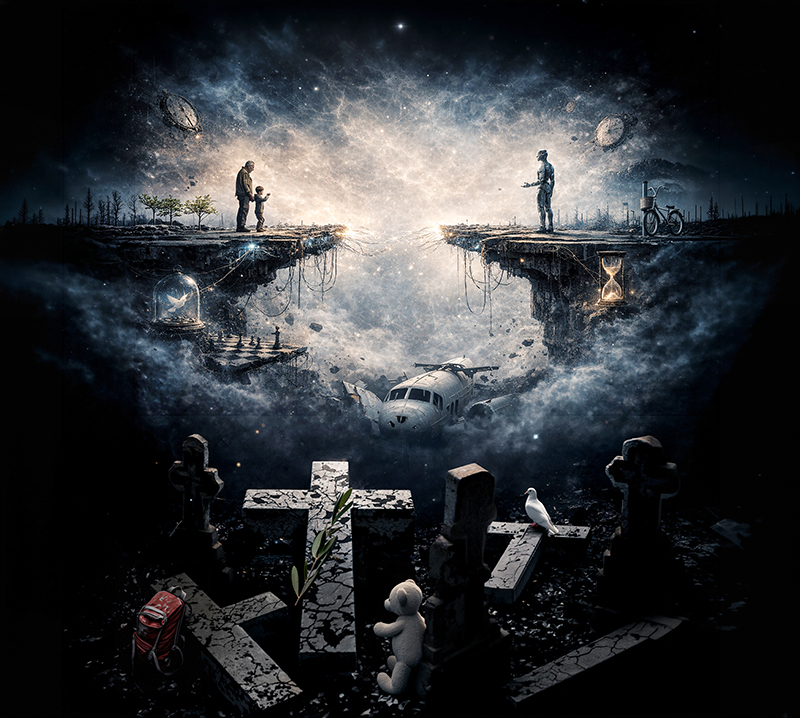
The synthesis-image of the entire project. Two ruptured banks look at each other across a luminous fault: on one, an old man holds a child's hand, beside two young trees; on the other, an android silhouette and an abandoned bicycle. Below them hangs an hourglass, a chess board, a dove enclosed under a glass bell. In the foreground, a cracked cemetery, a teddy bear, a child's schoolbag, an olive branch. The bridge is missing precisely where it would be most needed — between generations, between organic and synthetic, between what has been and what is to come. It is not a ruin, but a question left open.
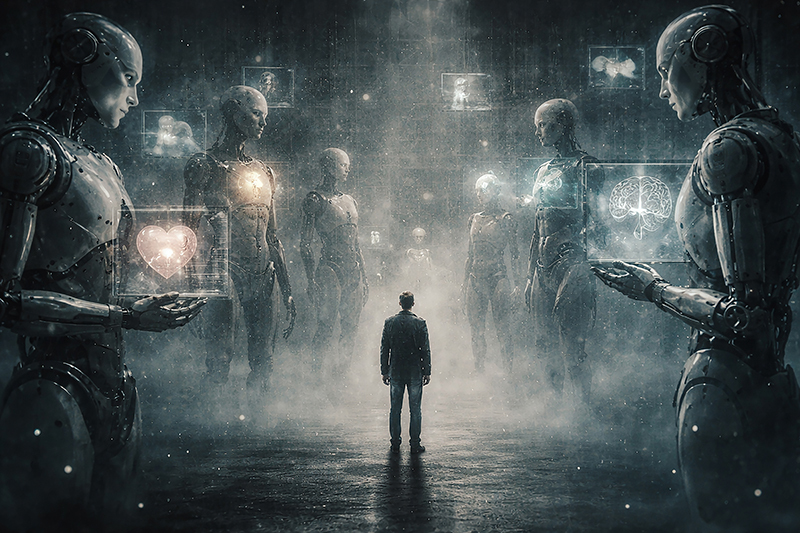
A single human being, small, from behind, between two rows of machines that flank him like a synod. The robots do not judge him — they offer: one extends a heart, another a brain, each enclosed in luminous screens. Around them float framed images, like evidence. The work inverts the usual human–machine hierarchy: here technology holds in its palms what the human risks no longer being able to carry alone. The witness does not testify — he is asked to recognise what he has delegated.
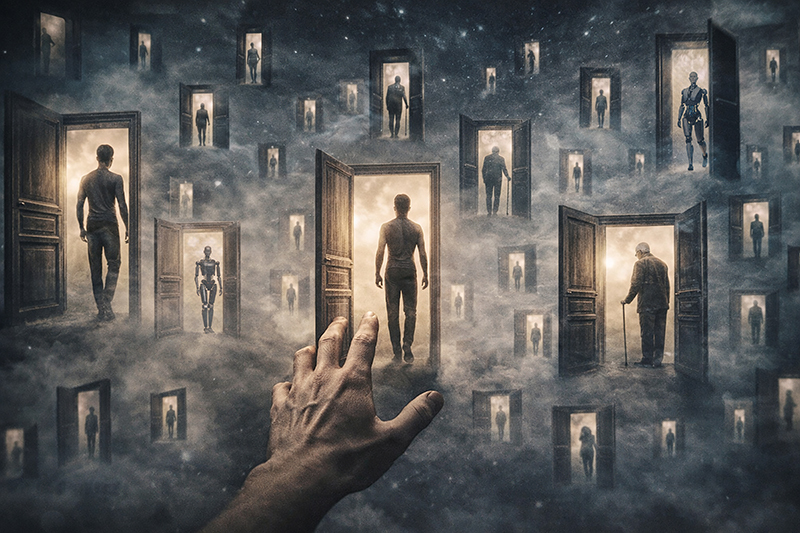
A field of doors floating in cosmic mist, each open, each with a silhouette walking away — young people, an old man with a cane, a robot. A massive human hand enters from the foreground and reaches towards one of them. Choice is no longer a point of decision, but an architecture: too many thresholds open simultaneously, each leading towards another version of the one who chooses. The gesture of the hand remains suspended — it touches the frame, has not yet crossed the threshold.
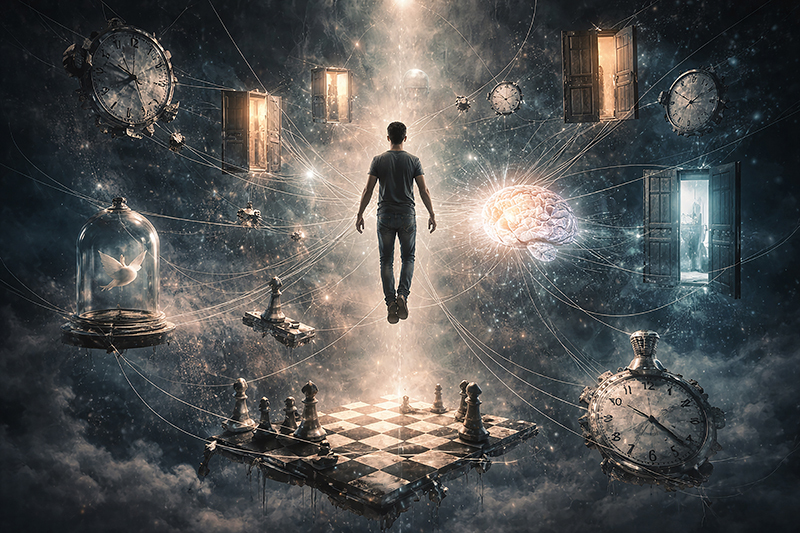
A human suspended in the void, from behind, connected by hundreds of thin threads to the objects surrounding him: clocks, doors, a luminous brain, a dove under a glass dome, a chess board. He does not hold the threads, and the threads do not hold him — the relationship is undecided. The atlas is no longer a map you read, but a network in which you are caught as a node. Each thread is a decision that is neither completely yours nor completely the system's.
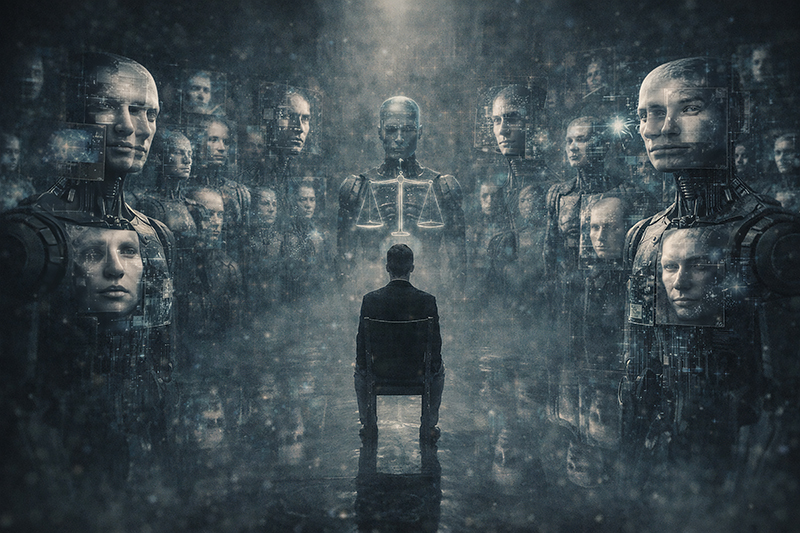
A man in a suit, from behind, seated on a simple chair, in front of a tribunal of hybrid figures: machines over which human faces are superimposed, and in the centre, a silhouette bears the scales of justice drawn on its chest. Judgement no longer comes from humans, nor purely from machines, but from their zone of fusion. The almost-empty chair of the accused and the light from above leave the verdict unpronounced: the work exposes the procedure, not the sentence.
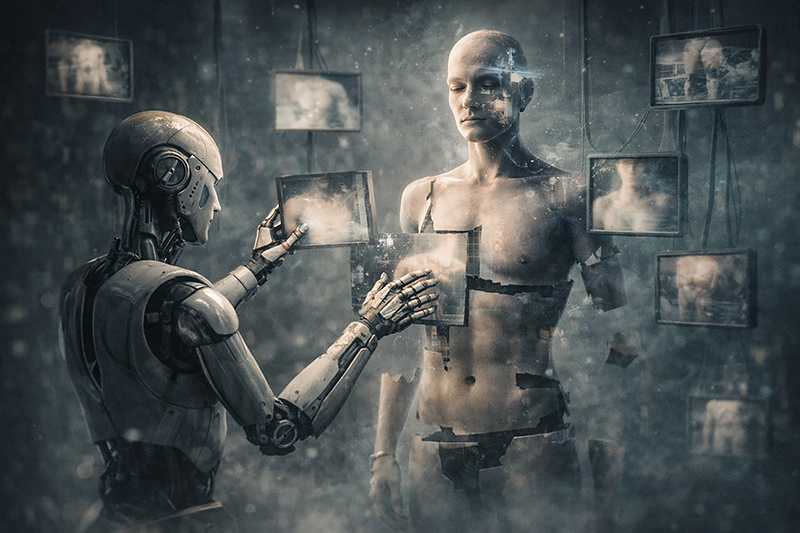
A robot and a human being extend to each other a fragment of an image. The human body unravels at its edges into rectangular tiles — it disintegrates like a corrupted file — while around them hang framed photographs, linked by cables. The exchange is both transfer and loss: what passes from human to algorithm is not copied, it is moved. Memory becomes an archive maintained from outside, and its maintenance has a price visible in the very body of the one who remembers.
The infrastructural valence of the project · emblem-image launched on this occasion · curated by the author.
Exhibition opened together with the launch of the monograph De la real la augmentat.
The project The Uncreated Bridge is part of the monograph De la real la augmentat. Artistul vizual în epoca post-fotografică (Reșița, 2026), where it is developed as a case study of personal artistic practice, in chapter 19.
Details about the book →