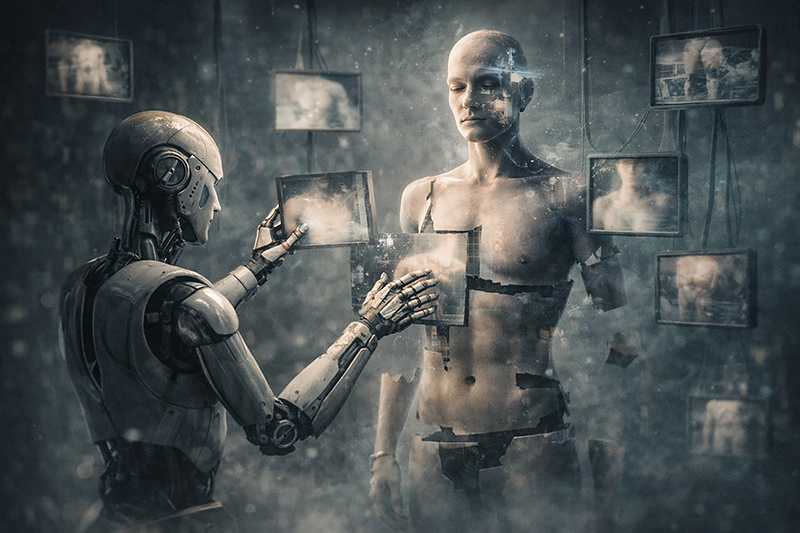
Photography lived for a long time on its involuntary authority. It did not need to argue — it simply existed, as a trace of a contact, as proof that the world had been there, that the moment had passed through the light of the camera. This almost contractual relationship between image and reality functioned so deeply within visual culture that it was rarely questioned: a photograph did not interpret, it documented. Or so the myth went.
Today, this myth has dissolved — not abruptly, not dramatically, but through a slow and unannounced erosion. No precise moment marks the rupture. There is no date from which the image ceased to be proof. It was rather a slide: first discreet post-processing, then aggressive retouching, then digital editing as norm, and finally, generative artificial intelligence — which no longer captures, but produces. The image no longer needs the world as a point of departure. It can be constructed entirely from data, from probabilities, from patterns extracted from millions of previous images. It is, in this sense, an image about images — a synthesis that simulates origin without possessing it.
This is not, however, a crisis. Or, if it is, it is the kind of crisis that liberates more than it destroys.
In my own practice, photography long ago ceased to be a finality. It remains a point of entry — a visual pretext, a trace, a texture of the real that I process, decompose, and reconfigure. Not out of distrust of the real, but out of the conviction that the real alone is not sufficient to say what I want to say. Digital intervention, visual reinterpretation, the integration of generated elements are not acts of falsification — they are acts of thought. They are the moments in which the work becomes a question, not an answer.
The result of this process is, intentionally, ambiguous. Recognisable elements of the image are partly preserved — enough to activate the viewer's memory, not enough to offer certainty. The rest is distorted, symbolised, reconstructed. The viewer faces an object that refuses to declare itself: neither pure document nor pure fiction. It is precisely this undecidability that interests me. Not as effect, but as position — as a place from which the image can pose questions that an ordinary photograph cannot afford.