Between Times explores the relationship between memory, image, and temporality in the context of post-photography. The series starts from a fundamental observation: in the traditional photographic paradigm, time was fixed in a luminous trace — evidence of its passing. In the algorithmic era, however, time becomes fluid, reversible, and reconfigurable, translated into datasets, probabilities, and automated visual interpretations.
The project proposes a poetic archive of instability — an augmented memory that refuses fixity and accepts transformation as a form of visual truth. The works do not reproduce reality; they simulate it poetically, constructing territories of reflection and contemplation at the boundary between document and simulacrum, between the analogue traces of light and the automatically generated numerical structures.
The project aligns with Walter Benjamin's reflections on the disappearance of the aura in technical reproduction and Lev Manovich's concept of image-as-process — the digital image as flux and transformation, not as a static object.
The critical reflection of the series translates into visual language what Roland Barthes described as the punctum — the detail that pierces the gaze and restores an affective connection with the past. In this case, the punctum does not arise from reality, but from the improbable textures generated by the algorithm, which become bearers of a paradoxical emotion: the artificial evoking the authentic.
The experience of the works is contemplative, almost meditative. The images do not offer a narrative, but a state: the suspension between memory and projection — in accord with the concept of the slow image formulated by Hito Steyerl, advocating for slow and reflexive perception amid the accelerated visual flux of contemporaneity.
The series was created through algorithmic generation in Adobe Photoshop, starting from textual descriptions conceived to evoke themes such as suspended memory, fragments of time, traces of reality, and space between worlds. The process included three distinct stages:
In this configuration, technology functioned as a creative partner — while control over the final meaning remained in the hands of the artist.
The project Between Times confirms the functionality of the Attention–Intention–Message triad as an instrument of construction and reading:
The triad functions simultaneously as an operational guide to the process and as a verifiable analytical framework.
The series comprises six works: The City of Time, The Genealogy of Time, Dialogue in Time, The Resistance of Time, The Bearers of Time, and The Miner of Time. The recurring symbols — the hourglass, the clock, the human silhouette, the tree — are reconfigured and situated in oneiric visual spaces, each proposing a distinct relationship with time as living matter and malleable element.

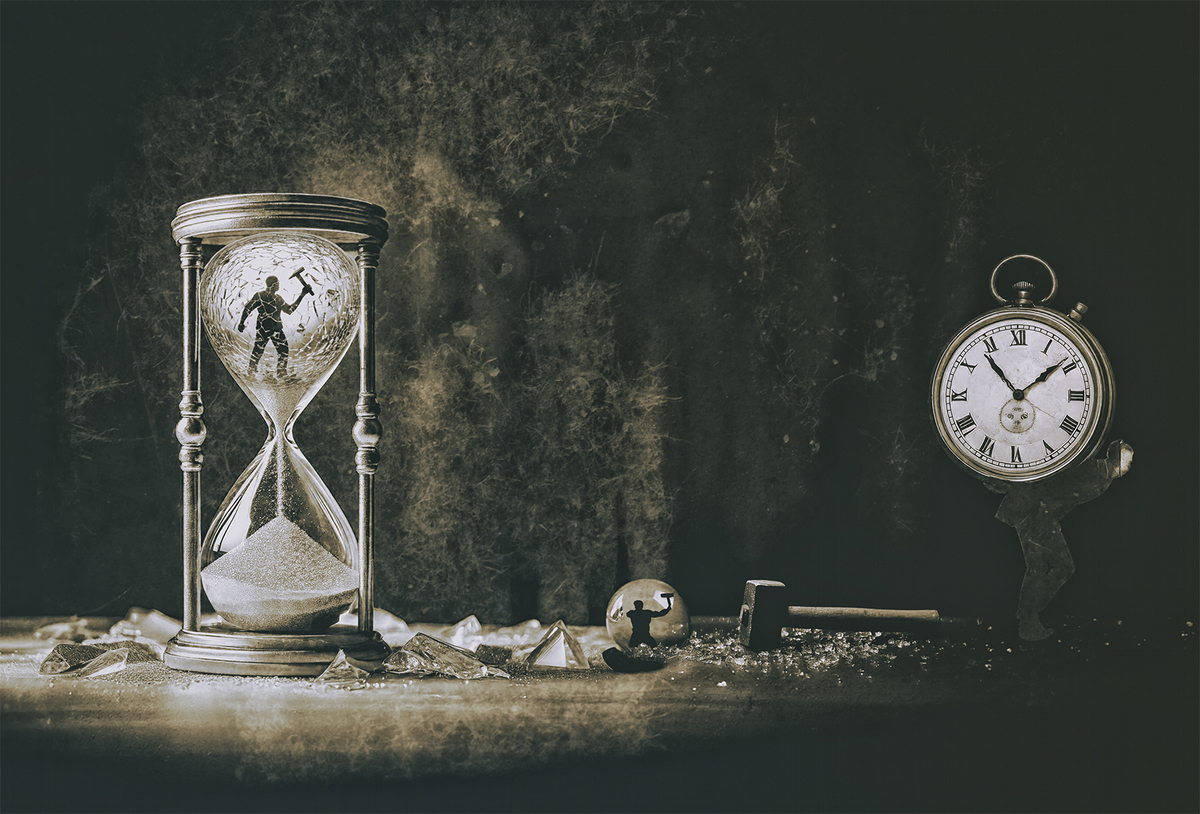


Between Times asserts itself as a unified artistic research in which the author assumes the role of builder of mental spaces — architect of visual introspection. The aesthetics of paradox and fragility define this endeavour: the paradox between cold technology and the affective charge of the image, the fragility between symbol and body, between matter and meaning.
The digital artist is not merely a technician of the image, but a visual thinker — one who transforms time into an artistic material, memory into a plastic texture, and introspection into a symbolic landscape.
Project documented and analysed in the volume From Real to Augmented. The Visual Artist in the Post-Photographic Era (2026), Chapter 19.